LearningApps.org
Are you sure you know your ABCs in Greek? Have you studied meticulously to learn the alphabet? If you want to practice reading seamlessly, now is your chance to prove to yourself that you know your letters!
Here are 6 activities created using LearningApps.org’s interactive multimedia applications, crafted with care and attention to detail by yours truly, Lexi, your Greek language instructor.
LearningApps is a non-profit organization that allows tutors like me to share our work for free, pouring our hearts into these resources. Please consider donating to this non-profit that aligns with Hellenic High’s principle of putting students first.
Activity 1: Know Your Consonants
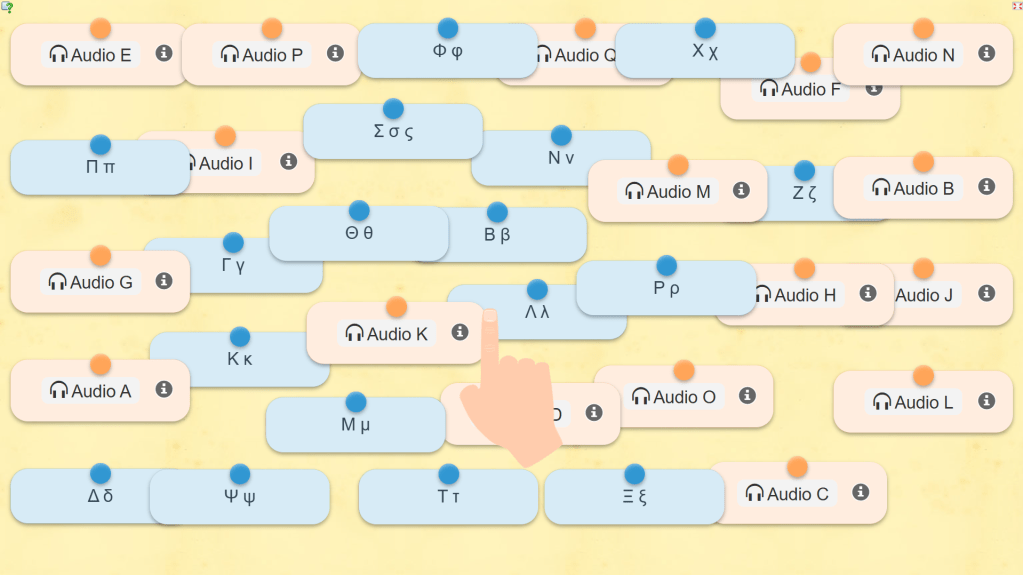
This activity is designed to test your knowledge, understanding, and listening skills, focusing specifically on consonants. Hover over the ‘i’ icon to see the meaning of each word. Click on the ‘Audio’ button to hear the corresponding sound.
Drag the cards to match the consonant with the sound it produces. The audio includes all possible combinations of the consonant with every vowel sound (e.g., βα, βε, βι, βο, βου), alongside a sample word (e.g., βαμβάκι), and the word used with an article or particle (e.g., το βαμβάκι). This ensures that, regardless of your proficiency level, the activity remains both challenging and enjoyable.
Start here: How does this consonant sound? or click on the image
Activity 2: Practice Your Consonants with Vowels
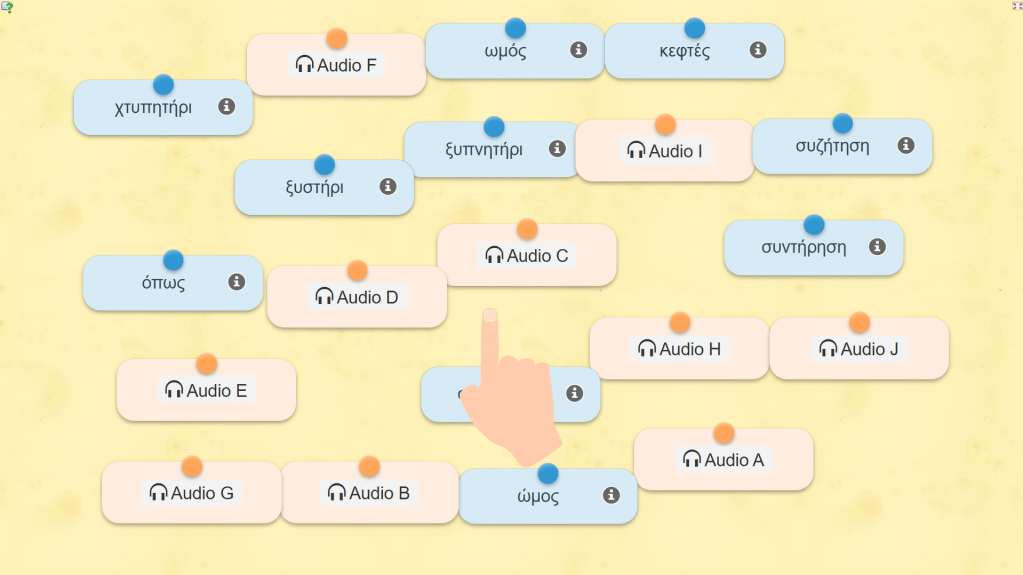
Now that you’ve mastered the consonants, let’s listen to and read more words to match! Hover over the ‘i’ icon to see the meaning of each word. Click on the ‘Audio’ button to listen to the pronunciation of the words. Drag the cards to match the corresponding audio with the correct word.
Be careful, as some of them look and sound almost identical. Keep in mind that not only the spelling, but also the intonation matters. This activity focuses on vowels that appear different but sound identical to one another (e.g., ο=ω, η=ι=υ, etc.).
Start here: How does this WORD sound? PART 1 or click on the image
Activity 3: Keep Practicing Consonant+Vowels
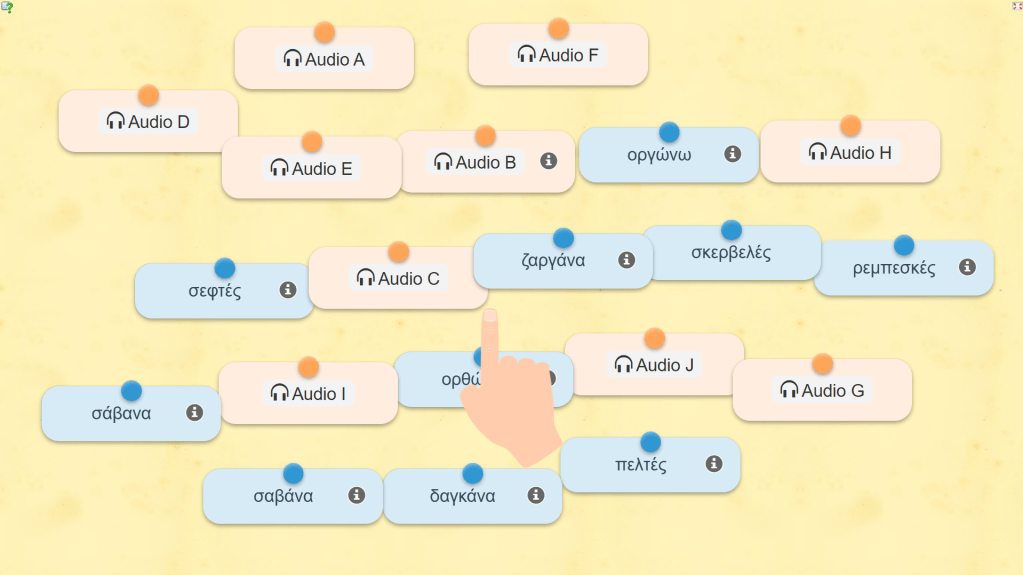
Practice makes progress! This activity is similar to Activity 2, but it focuses on different sounds. The goal of both activities is to emphasize the consistency of vowels.
There are only five vowel sounds in Greek (α, ε, ι, ο, ου), despite the different representations (e.g., ο=ω) and their placement within words (e.g., ‘άμπρα κατάμπρα’). Stay alert—there are traps to watch out for!
You’re doing an amazing job! Keep it up!
Start here: How does this WORD sound? PART 2 or click on the image
Activity 4: Consonants are Cool, But Digraphs Are Cooler
This activity focuses on consonant digraphs (i.e., two consonants that, when combined, produce a single sound found in Greek but not represented by a single letter). You will listen to the audio and drag the word you hear to the corresponding column. Fear not! I ensured that the digraph in question appears multiple times within the word of each audio, so you won’t miss it.
To further assist you with the -τσ- and -τζ- sounds, which are often the hardest to differentiate, I made sure that one of them has a slightly more pronounced accent and is voiced differently! Each category includes three words.
You know it by now: hover over the ‘i’ icon to see the meaning of each word. Click on the ‘Audio’ button to listen to the sound. Drag the cards and place them in the correct column.
Start here: How does this WORD sound? PART 3 or click on the image

Activity 5: Trust Your Ears for These Vowel Digraphs
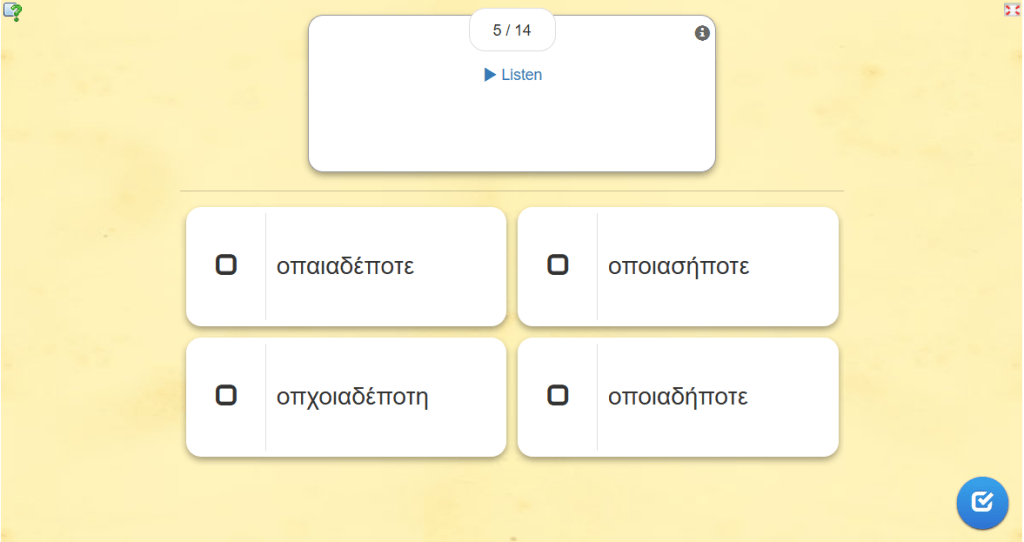
Now that we have all our sounds sorted out, it’s time to master listening to and reading vowel digraphs. In this multiple-choice activity, only the correct option is spelled accurately.
Don’t worry about knowing the vocabulary or the proper spelling just yet—simply trust your ears and memory. In this exercise, I might try to throw you off a bit. Can you keep your vowels straight? Have you studied your vowel digraphs? There’s only one way to find out! Which version do you hear? Click on the ‘i’ to discover the meaning of the word, listen to the audio, and choose the correct spelling based on what you hear.
Start here: How does this WORD sound? PART 4 or click on the image
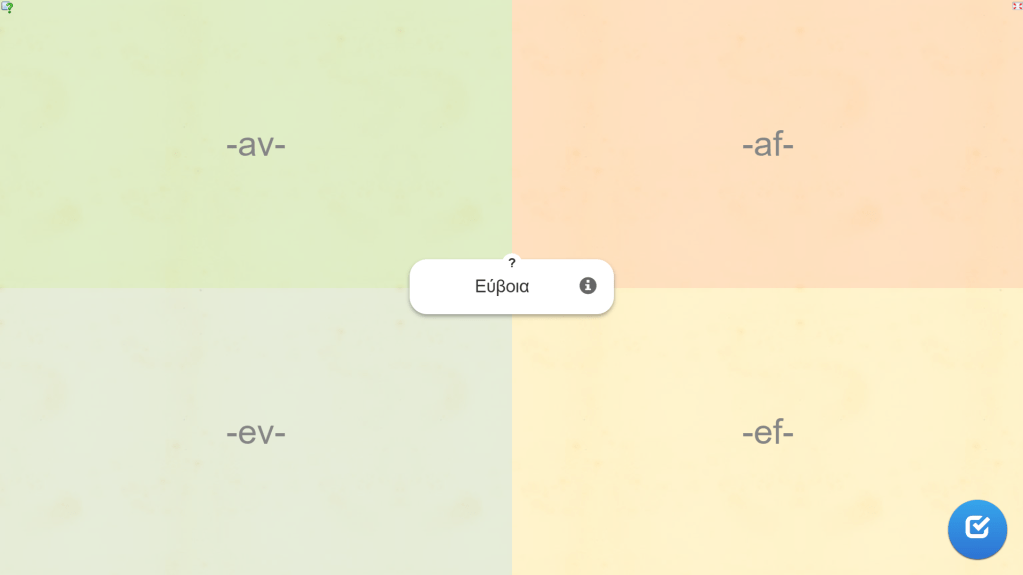
Activity 6: When Vowels MISBEHAVE.
Is this ‘Yυ’ an “f” or a “v”?
Last but not least, we couldn’t and wouldn’t miss this intriguing phenomenon. You’ve likely encountered the combinations “-ευ-“ and “-αυ-” in Greek words and wondered whether these combinations are simply unpredictable or if there’s more to discover.
Now, it’s important to focus! You must trust your reading skills and categorize each word that you come across into the correct box. Is this an “-αυ-” that sounds like “-av-” or “-af-“? Is this an “-ευ-” that sounds like “-ev-” or “-ef-“?
You. Got. This. Hover over the ‘i’ icon to see the meaning of each word.
Start here: ΑΥ & ΕΥ or click on the image
How Did It Go?
I’m sure you either nailed it or discovered a few new things to explore! Exploring is the reason you embarked on your journey to learn Greek in the first place. I’m proud of you, no matter the outcome, because you took the initiative to give it a shot!
If you’ve reached this point with more questions than answers, remember that uncertainty is a natural stage of the learning process. However, if you want to expedite your progress, I’m here to help!
Feel free to contact me for further questions, guidance, or instruction on your Greek learning journey! You got this!
 Hellenic High
Leave a comment